READ THE TEST, NOT JUST THE NUMBER

Performance.
With the conditions attached.

Published observations from independent reviewers, with model scope, measurement boundaries and source differences kept visible.

Evidence before a ranking.

Initial evidence covers three marketed portable-power models, four review records and two publishers. Independent surge testing, quantified low-temperature performance and degradation results have not been captured. Missing measurements are unknown, not zero; manufacturer ratings and editorial impressions are not substituted.

No combined score or best-product ranking is calculated. Manufacturer battery energy, delivered AC energy, recharge input, claimed surge watts and measured sound are different quantities.

Download the reviewed observation records · Creator review videos

ONE PUBLISHER, ONE STATED METHOD

AC energy reported in GearLab’s test.

Descriptive comparison within the publisher’s stated protocol: approximately 80% of each station’s rated output, full to exhausted. Targets scale with each model’s rating; actual per-run watts are not reported. Temperature, revision and firmware are unreported. This is not a fixed-load efficiency ranking.

Common visual scale: 0–1,000 Wh delivered. This is not a percentage of rated battery energy.

  1. Anker SOLIX C1000 Gen 2
    890 WhMethod & source details
  2. EcoFlow DELTA 3
    870 WhMethod & source details
  3. Jackery Explorer 1000 v2
    910 WhMethod & source details

Bars show delivered energy in Wh, not conversion efficiency. Different nominal capacities and actual loads prevent reading this as a universal efficiency comparison. The European 250 W observation below is outside this cohort.

Publisher protocol · No measurements have been averaged or normalized to a different load.

Can these two observations be compared?

Choose two published values. The scope check uses explicitly reviewed cohorts, metric boundaries and source conflicts; matching units alone do not make test conditions equivalent.

Enable JavaScript to check a pair. All source observations and conditions remain readable below.

OutdoorGearLab · INDEPENDENT PUBLISHER RECORD

Anker SOLIX C1000 Gen 2
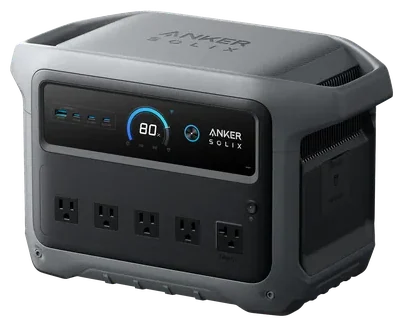
Catalog illustration: Anker SOLIX C1000 Gen 2 Portable Power Station
Catalog illustration; not the reviewer’s test sample. Sample SKU/revision remains unverified.

Applicability: Model/generation names match the catalog reference. Sample SKU, electrical-region verification, production revision and firmware are not established; this does not validate every retailer configuration.

Review author: Kenji Mowrey
Test attribution: GearLab power-station team; individual run operator not identified

Published 2026-07-23 · Source checked 2026-11-07 · Measurement date not reported. A new page capture is not a new test.

Read the original review · Read the stated method

Publisher says it buys review products and earns affiliate commissions. This is publisher-disclosed context, not a certification of independence.

Published observations and their individual scope
ObservationSource valueBoundary and limitations
Delivered AC energy890 WhPublisher-reported observation

Energy available through AC outlets

Source location: Measured Energy Output row / Power Output discussion
Measured weight25.2 lbPublisher-reported observation

Whole station; exact accessory inclusion not stated

Source location: Measured Weight row
Publisher usable-energy percentage, body87 %Conflicting source values — held

Delivered AC Wh / publisher-stated nominal Wh

Source location: Power Output discussion
Publisher usable-energy percentage, table80 %Conflicting source values — held

Source table; denominator conflicts with body

Source location: Usable Capacity table row
Charge-time statement, body56 minConflicting source values — held

AC recharge; exact mode and endpoints not tied to this value

Source location: Charge Speed discussion
Charge-time statement, table0.8 hConflicting source values — held

AC recharge; precise mode linkage unresolved

Source location: Time to Charge row
Publisher charging-rate value1097 Wh/hrMeasurement boundary unresolved — held

Publisher energy-per-time calculation; not verified as metered AC input watts

Source location: Measured Charging Speed row and Charge Speed discussion

Differences retained in the evidence

  • Body: 1,024 Wh nominal and 87% usable. Table: 1,056 Wh and 80%. Delivered AC energy is 890 Wh in both contexts; percentages and denominators are retained separately. Original source
  • Body states 56 minutes and also mentions a 49-minute ultrafast option; table lists 0.8 hours. Mode linkage is unresolved. Timing is held rather than selecting one figure. Original source
Test conditions, manufacturer claims and source record

What is known about this test

Tested regional hardware
Not explicitly identified for the individual sample
Actual AC load (W)
Not reported
Load protocol
approximately 80 percent of each unit rated output
AC output voltage (V)
Not reported
Ambient temperature (°C)
Not reported
Firmware
Not reported
Hardware revision / sample SKU
Not reported
Measurement date
Not reported
Repeated runs
Not reported
Instrument model
Not reported
Starting state of charge (%)
100
Ending state of charge (%)
0
Endpoint / stopping rule
Publisher method: fully charged to exhausted

Condition notes attached to an individual observation take precedence over the study’s discharge conditions. Charging energy and sound measurements do not inherit the discharge load.

Manufacturer claims — separate from the test

1,024 Wh rated battery energy · 2,000 W rated AC output. Official US product specifications; claims are separate from independent measurements.

Official product specifications · reviewed 2026-11-07

Source capture

direct capture · captured 2026-11-08T01:24:18.032671+00:00 · SHA-256 127c344b32560b4cbabe23330ea91184bd0195ab5b3a3431b1734e5c14bca1d8
OutdoorGearLab · INDEPENDENT PUBLISHER RECORD

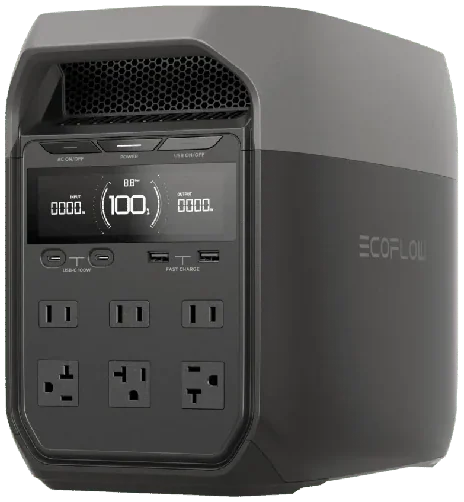
EcoFlow DELTA 3

Catalog illustration: EcoFlow DELTA 3 Portable Power Station
Catalog illustration; not the reviewer’s test sample. Sample SKU/revision remains unverified.

Applicability: Model/generation names match the catalog reference. Sample SKU, electrical-region verification, production revision and firmware are not established; this does not validate every retailer configuration. DELTA 3 Plus, Classic, Max and bundled expansion systems are separate.

Review author: Kenji Mowrey
Test attribution: GearLab power-station team; individual run operator not identified

Published 2026-07-23 · Source checked 2026-11-07 · Measurement date not reported. A new page capture is not a new test.

Read the original review · Read the stated method

Publisher says it buys review products and earns affiliate commissions. This is publisher-disclosed context, not a certification of independence.

Published observations and their individual scope
ObservationSource valueBoundary and limitations
Delivered AC energy870 WhPublisher-reported observation

Energy available through AC outlets

Source location: Measured Energy Output row / Power Output discussion
Measured weight28.1 lbConflicting source values — held

Whole station; exact accessory inclusion not stated

Source location: Measured Weight row
Publisher recharge time, body50 minConflicting source values — held

AC recharge; exact mode linkage unreported

Source location: Likes discussion
Publisher recharge time, table0.9 hConflicting source values — held

AC recharge; possible rounding or mode difference unresolved

Source location: Time to Charge row
Publisher charging-rate value, body1299 Wh/hrConflicting source values — held

Publisher energy-per-time value

Source location: Likes discussion
Publisher charging-rate value, table1229 Wh/hrConflicting source values — held

Publisher energy-per-time value

Source location: Measured Charging Speed table row
Measured-weight statement, body28.2 lbConflicting source values — held

Whole station; source table instead gives 28.1 lb

Source location: Dislikes discussion

Differences retained in the evidence

  • Body: 50 minutes and 1,299 Wh/hr. Table: 0.9 hours and 1,229 Wh/hr. Conditions or rounding do not resolve the differences in the reviewed source; both versions are retained and held. Original source
  • Table: 28.1 lb; body: 28.2 lb. The source does not identify whether rounding or sample/accessory differences explain this. Both values are retained. Original source
Test conditions, manufacturer claims and source record

What is known about this test

Tested regional hardware
Not explicitly identified for the individual sample
Actual AC load (W)
Not reported
Load protocol
approximately 80 percent of each unit rated output
AC output voltage (V)
Not reported
Ambient temperature (°C)
Not reported
Firmware
Not reported
Hardware revision / sample SKU
Not reported
Measurement date
Not reported
Repeated runs
Not reported
Instrument model
Not reported
Starting state of charge (%)
100
Ending state of charge (%)
0
Endpoint / stopping rule
Publisher method: fully charged to exhausted

Condition notes attached to an individual observation take precedence over the study’s discharge conditions. Charging energy and sound measurements do not inherit the discharge load.

Manufacturer claims — separate from the test

1,024 Wh rated battery energy · 1,800 W rated AC output. Official US product specifications; claims are separate from independent measurements.

Official product specifications · reviewed 2026-11-07

Direct capture was unavailable or rate limited; separately reviewed publisher-indexed text. No bypass attempted.

Source capture

direct capture · captured 2026-11-08T01:24:18.542034+00:00 · SHA-256 c774492e6733eccc067cc3bbb88d37b1924c3232e9ff4eb35c93c9bd91a37dc9

OutdoorGearLab · INDEPENDENT PUBLISHER RECORD

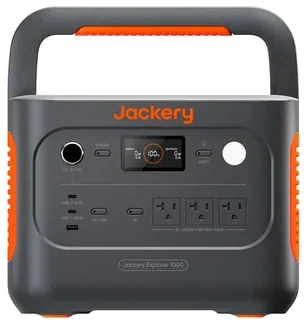
Jackery Explorer 1000 v2

Catalog illustration: Jackery Explorer 1000 v2
Catalog illustration; not the reviewer’s test sample. Sample SKU/revision remains unverified.

Applicability: Model/generation names match the catalog reference. Sample SKU, electrical-region verification, production revision and firmware are not established; this does not validate every retailer configuration.

Review author: Kenji Mowrey
Test attribution: GearLab power-station team; individual run operator not identified

Published 2026-07-23 · Source checked 2026-11-07 · Measurement date not reported. A new page capture is not a new test.

Read the original review · Read the stated method

Publisher says it buys review products and earns affiliate commissions. This is publisher-disclosed context, not a certification of independence.

Published observations and their individual scope
ObservationSource valueBoundary and limitations
Delivered AC energy910 WhPublisher-reported observation

Energy available through AC outlets

Source location: Measured Energy Output row / Power Output discussion
Measured weight24.4 lbPublisher-reported observation

Whole station; exact accessory inclusion not stated

Source location: Measured Weight row
Publisher full AC recharge time1.58 hPublisher-reported observation

Publisher method: drained to full; charge mode and actual endpoints unreported

Source location: Time to Charge row; Dislikes uses a rough almost-two-hour description
Publisher charging-rate value563 Wh/hrMeasurement boundary unresolved — held

Publisher energy-per-time value; not verified as metered AC input watts

Source location: Measured Charging Speed row and Dislikes discussion

Differences retained in the evidence

  • Official product technical table: 1,070 Wh. Navigation label: 1,024 Wh. The test describes 1,070 Wh; exact current ordering-SKU applicability remains unverified. Original source · Original source
Test conditions, manufacturer claims and source record

What is known about this test

Tested regional hardware
Not explicitly identified for the individual sample
Actual AC load (W)
Not reported
Load protocol
approximately 80 percent of each unit rated output
AC output voltage (V)
Not reported
Ambient temperature (°C)
Not reported
Firmware
Not reported
Hardware revision / sample SKU
Not reported
Measurement date
Not reported
Repeated runs
Not reported
Instrument model
Not reported
Starting state of charge (%)
100
Ending state of charge (%)
0
Endpoint / stopping rule
Publisher method: fully charged to exhausted

Condition notes attached to an individual observation take precedence over the study’s discharge conditions. Charging energy and sound measurements do not inherit the discharge load.

Manufacturer claims — separate from the test

1,070 Wh rated battery energy · 1,500 W rated AC output. Official US product specifications; claims are separate from independent measurements.

Official technical table specifies 1,070 Wh / 120 V, while navigation labels say 1,024 Wh. Confirm the ordering SKU; do not assign these results to HomePower 1000 v2 or a different capacity variant.

Official product specifications · reviewed 2026-11-07

Direct capture was unavailable or rate limited; separately reviewed publisher-indexed text. No bypass attempted.

Source capture

direct capture · captured 2026-11-08T01:24:18.292937+00:00 · SHA-256 8227560237fabd4e0947ab67fbe70cfc0732bec3876b47f3bbb6dec3f6411400

Notebookcheck · INDEPENDENT PUBLISHER RECORD

Anker SOLIX C1000 Gen 2 — European test unit

Catalog illustration: Anker SOLIX C1000 Gen 2 Portable Power Station
Catalog illustration; not the reviewer’s test sample. US catalog image; the source tested European hardware.

Applicability: Publisher explicitly reviewed the European version and warns that the US version differs. This is context for the marketed model, not a measurement of the US catalog hardware.

Review author: Marcus Schwarten; English translation credited to DeepL / Marcus Schwarten
Test attribution: Marcus Schwarten; publication does not supply run-level operator details

Published 2025-12-21 · Source checked 2026-11-07 · Measurement date not reported. A new page capture is not a new test.

Read the original review · Read the stated method

Publisher discloses a free manufacturer-supplied sample, no manufacturer preview and no obligation to publish. Paid sponsorship is not established by the reviewed text.

Published observations and their individual scope
ObservationSource valueBoundary and limitations
Delivered AC energy at about 250 W850 WhPublisher-reported observation

230 V AC discharge until displayed 1%

Source location: Practice: Charges in under an hour
Metered AC recharge input1110 WhPublisher-reported observation

Energy entering through AC charging; not delivered AC energy

A charging measurement, not the 250 W discharge condition

Source location: Practice discussion, AC charging measurement
Reported sound levelAbout 45 dBPublisher-reported observation

Sound measurement at 1 m; weighting/background and exact load unreported

Higher output / fast charging; do not assume the 250 W discharge load

Source location: Practice discussion, noise at higher output and fast charging
Publisher delivered / nominal energy ratio83 %Publisher-reported observation

850 Wh delivered / 1,024 Wh nominal; not round-trip efficiency

Source location: Practice discussion, AC discharge
Publisher nominal / recharge-input ratio92 %Publisher-reported observation

1,024 Wh nominal / 1,110 Wh AC input; not metered discharge efficiency or round-trip efficiency

Source location: Practice discussion, AC recharge
Test conditions, manufacturer claims and source record

What is known about this test

Tested regional hardware
European version, explicitly identified
Actual AC load (W)
250
Load protocol
approximately constant ac
AC output voltage (V)
230
Ambient temperature (°C)
Not reported
Firmware
Not reported
Hardware revision / sample SKU
Not reported
Measurement date
Not reported
Repeated runs
Not reported
Instrument model
Not reported
Starting state of charge (%)
Not reported
Ending state of charge (%)
1
Endpoint / stopping rule
Discharge stopped with display showing 1%; exact start state not stated

Condition notes attached to an individual observation take precedence over the study’s discharge conditions. Charging energy and sound measurements do not inherit the discharge load.

Manufacturer claims — separate from the test

1,024 Wh rated battery energy · 2,000 W rated AC output. Official US specifications only; regional equivalence to the test unit is not established.

Official product specifications · reviewed 2026-11-07

Source capture

direct capture · captured 2026-11-08T01:24:18.954344+00:00 · SHA-256 5997d2e3f862e83138a26d0ae18b17fedfce5944479ba13c57f92aa9e0317d2a

Coverage, rights and corrections.

Factual measurements are attributed and briefly paraphrased. Publisher articles, photographs and graphs are not reproduced; no republication licence is asserted. Catalog photos identify the model and are not photographs of the publisher’s test sample. SolarCompare has not performed these tests.

Figures with conflicting or unclear boundaries stay in their source records and are held from comparison. Missing methods, firmware, temperature, instrument details and sample revisions remain unknown. Source dates and test dates stay separate. Revised source evidence can change a record without rewriting its historical publication date.

Catalog associations are explicit marketed-model references. They are not a promise that every US offer matches the reviewer’s sample. No independent result is inserted into manufacturer filters or runtime calculations.

Our sources and affiliate disclosure