BUYING QUESTION 01
Why two 1 kWh batteries can deliver different runtimes.
Trace the energy boundary before comparing the number on the box.
Read the illustrated explainerTHE ILLUSTRATED RESEARCH LIBRARY
Start with the question you need answered. Trace the units, conditions and missing evidence before choosing equipment.
BUYING QUESTION 01
Trace the energy boundary before comparing the number on the box.
Read the illustrated explainerBUYING QUESTION 02
Put age, cycling and the test endpoint beside a lifespan claim.
Read the illustrated explainerBUYING QUESTION 03
Compare module area, electrical limits and the actual resource.
Read the illustrated explainerBUYING QUESTION 04
Write the input and output boundary beside every percentage.
Read the illustrated explainerBUYING QUESTION 05
Separate what was observed from confidence in applying it.
Read the illustrated explainerBUYING QUESTION 06
Look beyond the battery module to the complete operating configuration.
Read the illustrated explainerCLAIMS → OBSERVATIONS → APPLICABILITY
Screen three explicitly referenced portable-power models against a steady AC load, running from the battery without charging. Keep running watts and required energy separate from measured performance and evidence confidence.
This screen excludes motor starts, intermittent/duty-cycle loads, temperature and aging adjustments, and charging while in use. Starting-load and whole-system suitability require separate checks.
Task inputs stay in this page’s memory; they are not saved, sent or added to the URL. No account is needed.
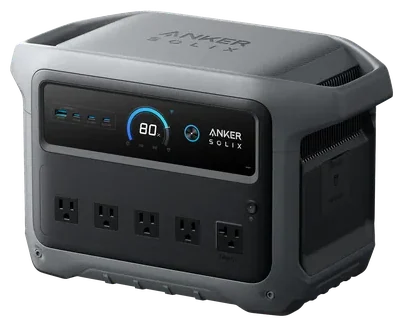
Catalog illustration, not the reviewer’s sample.
MANUFACTURER CLAIMS · NOT TEST RESULTS
1,024 Wh nominal · 2,000 W continuous AC claim
Default 200 W task is below the stated continuous rating, with 1,800 W claim-based headroom. Starts are excluded.
Default 400 Wh is below nominal capacity. This does not establish delivered AC energy or runtime.
Official specification source · reviewed 2026-11-07
PUBLISHED OBSERVATIONS · THEIR ORIGINAL LOAD
Energy available through AC outlets
Whole station; exact accessory inclusion not stated
GearLab relative-load protocol: approximately 80% of each unit’s rating. Actual W unreported; not converted to runtime at your load.
Method, review source and all observations · published 2026-07-23 · reviewed 2026-11-07
5 source observation records held from numeric comparison; see the original conflicts and boundaries.
EVIDENCE FIT / CONFIDENCE · SEPARATE FROM PERFORMANCE
Exact-task runtime unverifiedModel/generation names match the catalog reference. Sample SKU, electrical-region verification, production revision and firmware are not established; this does not validate every retailer configuration.
Next: confirm the ordering SKU and request a measured AC runtime at 200 W, with temperature and stopping rule.
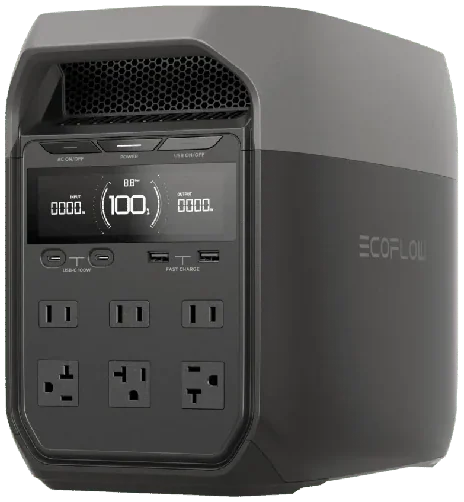
Catalog illustration, not the reviewer’s sample.
MANUFACTURER CLAIMS · NOT TEST RESULTS
1,024 Wh nominal · 1,800 W continuous AC claim
Default 200 W task is below the stated continuous rating, with 1,600 W claim-based headroom. Starts are excluded.
Default 400 Wh is below nominal capacity. This does not establish delivered AC energy or runtime.
Official specification source · reviewed 2026-11-07
PUBLISHED OBSERVATIONS · THEIR ORIGINAL LOAD
Energy available through AC outlets
GearLab relative-load protocol: approximately 80% of each unit’s rating. Actual W unreported; not converted to runtime at your load.
Method, review source and all observations · published 2026-07-23 · reviewed 2026-11-07
6 source observation records held from numeric comparison; see the original conflicts and boundaries.
EVIDENCE FIT / CONFIDENCE · SEPARATE FROM PERFORMANCE
Exact-task runtime unverifiedModel/generation names match the catalog reference. Sample SKU, electrical-region verification, production revision and firmware are not established; this does not validate every retailer configuration. DELTA 3 Plus, Classic, Max and bundled expansion systems are separate.
Next: confirm the ordering SKU and request a measured AC runtime at 200 W, with temperature and stopping rule.
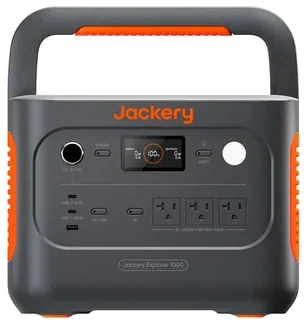
Catalog illustration, not the reviewer’s sample.
MANUFACTURER CLAIMS · NOT TEST RESULTS
1,070 Wh nominal · 1,500 W continuous AC claim
Default 200 W task is below the stated continuous rating, with 1,300 W claim-based headroom. Starts are excluded.
Default 400 Wh is below nominal capacity. This does not establish delivered AC energy or runtime.
Official technical table specifies 1,070 Wh / 120 V, while navigation labels say 1,024 Wh. Confirm the ordering SKU; do not assign these results to HomePower 1000 v2 or a different capacity variant.
Official specification source · reviewed 2026-11-07
PUBLISHED OBSERVATIONS · THEIR ORIGINAL LOAD
Energy available through AC outlets
Whole station; exact accessory inclusion not stated
GearLab relative-load protocol: approximately 80% of each unit’s rating. Actual W unreported; not converted to runtime at your load.
Method, review source and all observations · published 2026-07-23 · reviewed 2026-11-07
1 source observation records held from numeric comparison; see the original conflicts and boundaries.
EVIDENCE FIT / CONFIDENCE · SEPARATE FROM PERFORMANCE
Exact-task runtime unverifiedModel/generation names match the catalog reference. Sample SKU, electrical-region verification, production revision and firmware are not established; this does not validate every retailer configuration.
Next: confirm the ordering SKU and request a measured AC runtime at 200 W, with temperature and stopping rule.
Qualitative applicability reasons are shown separately from manufacturer claims and publisher observations. No probability, numerical confidence or universal product score is computed. A smaller reported Wh value is a performance observation; missing matching methods are an applicability gap. One is not converted into the other.
Below the nominal Wh claim means only that this energy screen has not ruled out the task. Above nominal Wh means the task exceeds that claim even before conversion/reserve allowances, under the stated no-charging assumption. Below rated W does not prove startup capability. Test energy is never divided by your watts to imply a runtime at a different load.
Coverage is targeted: three marketed models, one GearLab review per model, plus a separate European Anker record linked in the evidence library. This is not an exhaustive search. Exact-load runtime, repeatability, tested ordering SKU, cold behavior and long-term aging remain unresolved. A confidence probability and universal numeric best-product score are withheld.
Read all source observations and held differences · Build an actual load plan · Work with explicit runtime assumptions
Library revision research-library-1 · reviewed 2026-11-07. Each article keeps its own publication, review and correction history, with source capture dates. Rechecking an article is not a new experiment.
Original site illustrations authorized for SolarCompare publication; no third-party artwork is reproduced. Source documents and publisher media retain their own rights. Conceptual diagrams and explicitly hypothetical arithmetic. No illustration is a measured curve or manufacturer drawing.
These are targeted, AI-assisted editorial explainers and applicability checks; independent technical peer review has not been recorded. They do not replace the exact documentation. Source differences remain visible in the evidence record until resolved.
Download the article and source records · Practice the energy foundations · Sources and affiliate disclosure