CAPACITY MEETS YOUR LOADS
How long could
your battery last?.
Explore runtime with explicit energy boundaries, conversion losses, temperature allowance and reserve.
Two energy boundaries. Two accounting paths.
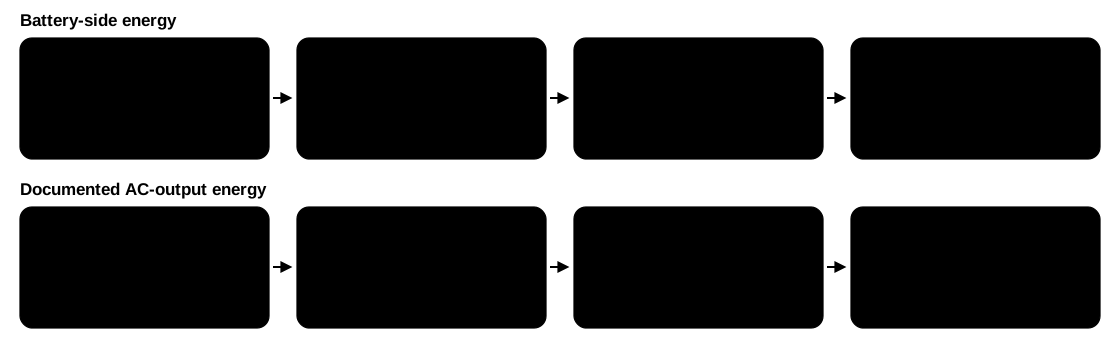
Start from a capacity you can identify.
Use a figure from the exact product’s documentation or enter your own assumption. Nominal capacity and documented usable energy are different. Confirm whether a usable figure is battery-side energy or energy already delivered at an AC outlet.
This divides your entered capacity into available energy, held reserve and your usable-share/temperature reductions. It is a scenario illustration, not a measured loss or a product test.
ENERGY AVAILABLE FOR THIS SCENARIO
MODELED ENERGY DRAW
ESTIMATED CONSTANT-LOAD RUNTIME
Starting loads, variable efficiency, aging and changing operating conditions are not automatically simulated.
Follow the calculation.
Runtime does not establish power capability or installation compatibility. A battery-only listing can still require an inverter and other equipment. Review the source conditions and the exact equipment’s continuous and starting limits.
Use a saved load plan.
The first choice treats marked running watts as constant. The second divides planned Wh/day by 24; it does not describe a shorter outage’s load pattern. Both enter an AC-load assumption that you can edit.
Build an appliance plan